

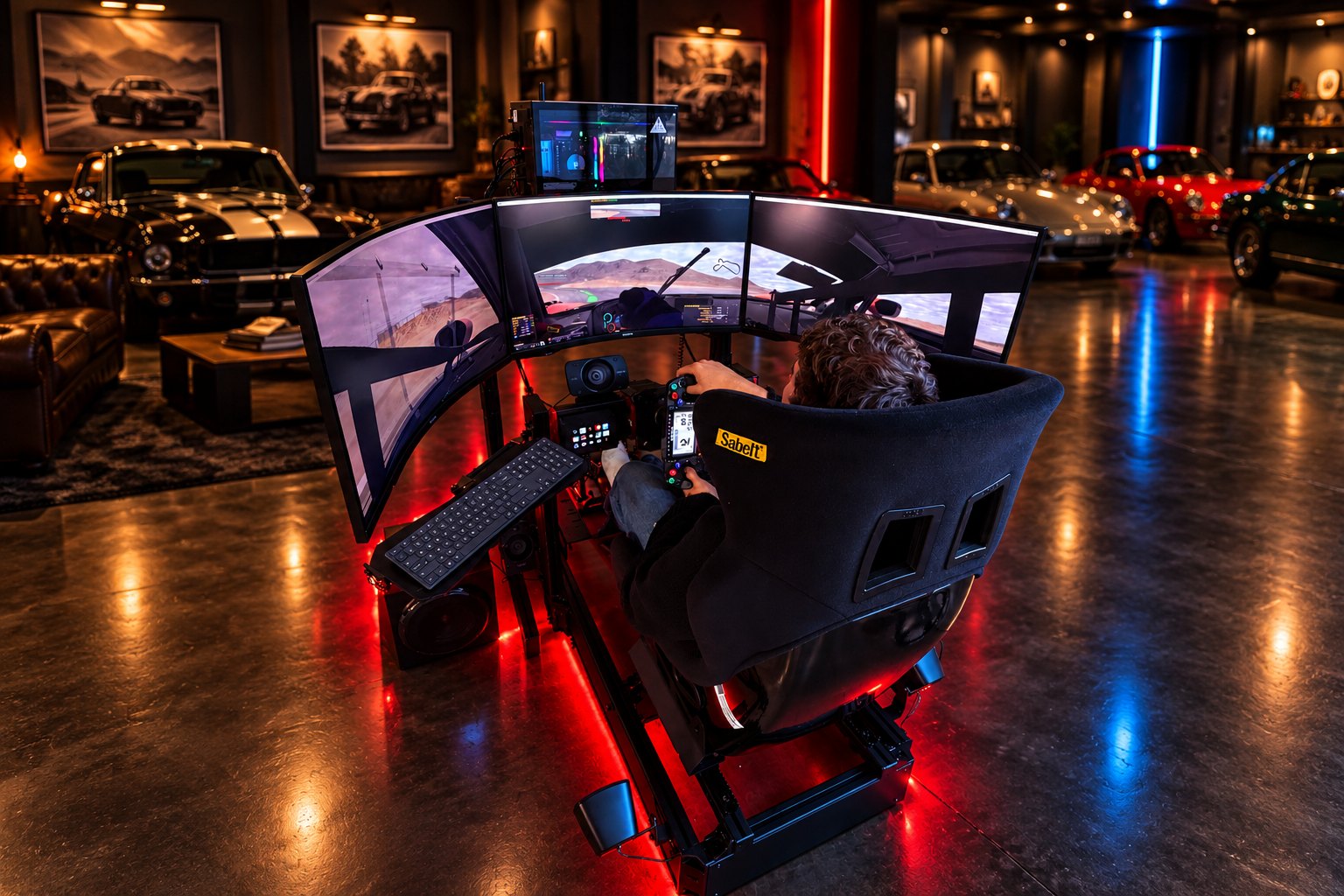
 Level 3 build · in session
Simulators · Built, tested, installed
Pro simulators,
built for your space.
Three levels of professional-grade simulator, specified by a driver coach rather than a parts list. Every build is assembled, pre-tested and professionally installed, then handed over with the software set up and a coach on the line if you want one.
The three levels
Pick a level.
All three are pro-spec. Level 1 is the base: a serious single-screen GT rig for track driving. Levels 2 and 3 step up significantly in equipment, material quality and the range of driving you can do on it: circuit racing, rallying, drifting and more. Pricing is clean and all-in: one figure covers the build, pre-test and installation, with a two-year warranty on the hardware.
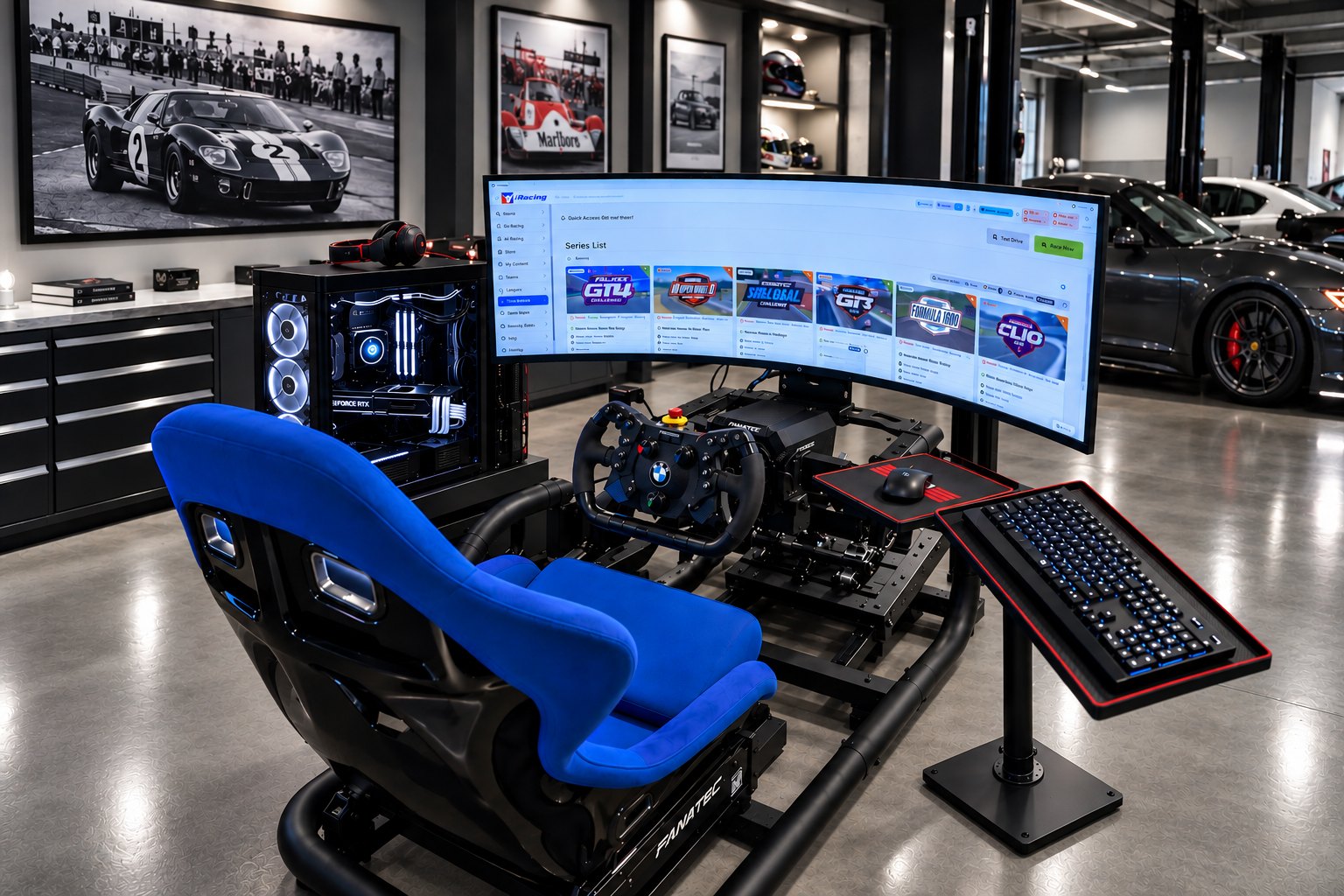
For the driver who wants a proper GT rig for track driving and coaching, without the extras. Smallest footprint: about 6 ft × 4 ft × 4 ft.
- GT chassis, 6 × 4 × 4 ft footprint
- L1 custom PC
- Direct drive wheel base
- Formula steering wheel
- GT sim seat
- Single ultra-wide UHD monitor
- Pro sim pedals
- Audio headset
- Keyboard and mouse
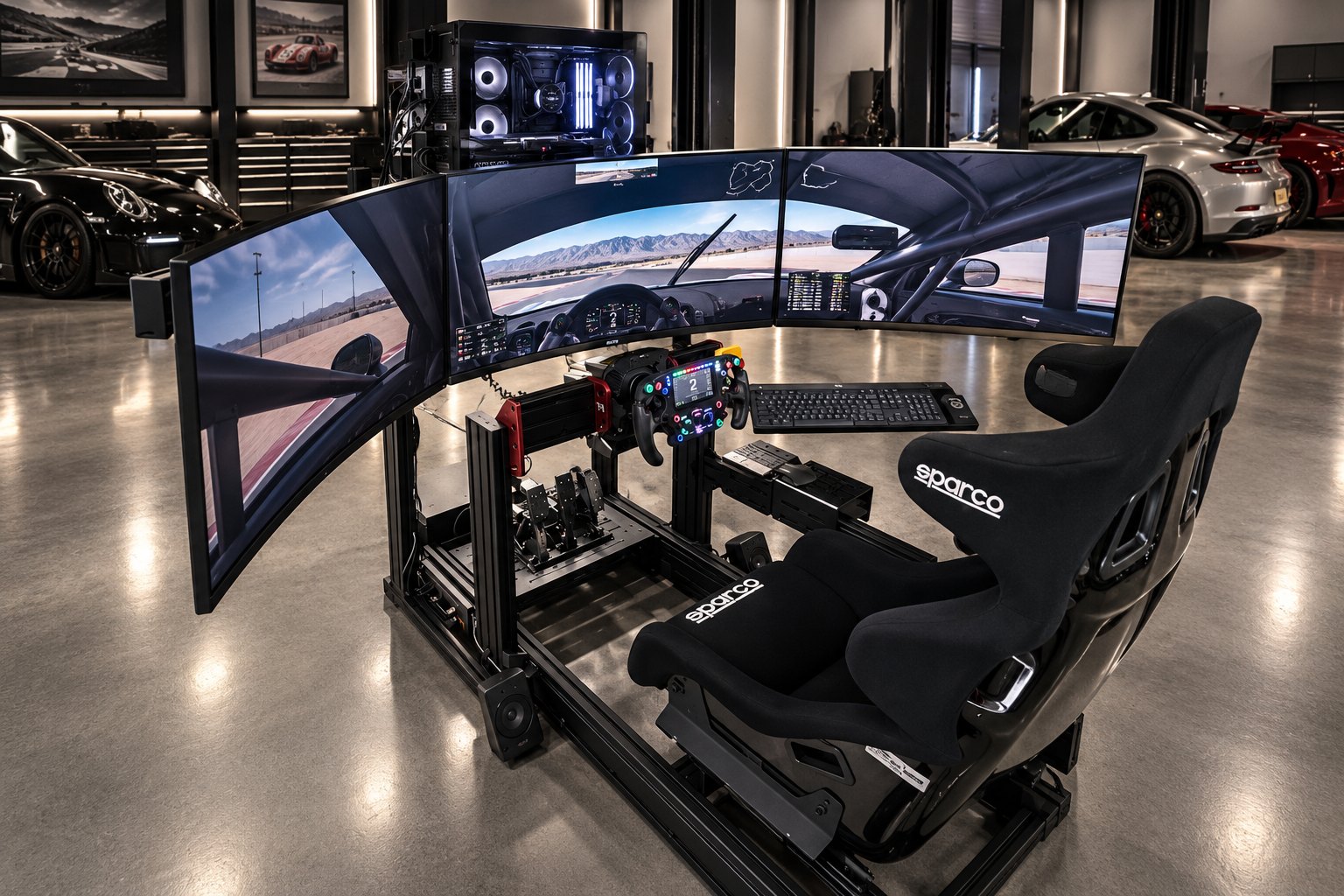
Circuit, rally and drift capable, with a pro chassis, triple-screen option and a hydraulic pedal box.
- Pro chassis
- L2 custom PC
- Direct drive wheel base
- Formula steering wheel and rally wheel
- Adjustable racing seat
- Triple UHD screen option
- H-pattern and sequential shifter
- Hydraulic racing pedal box
- Audio headset plus 5.1 surround speakers
- Keyboard, mouse and tray
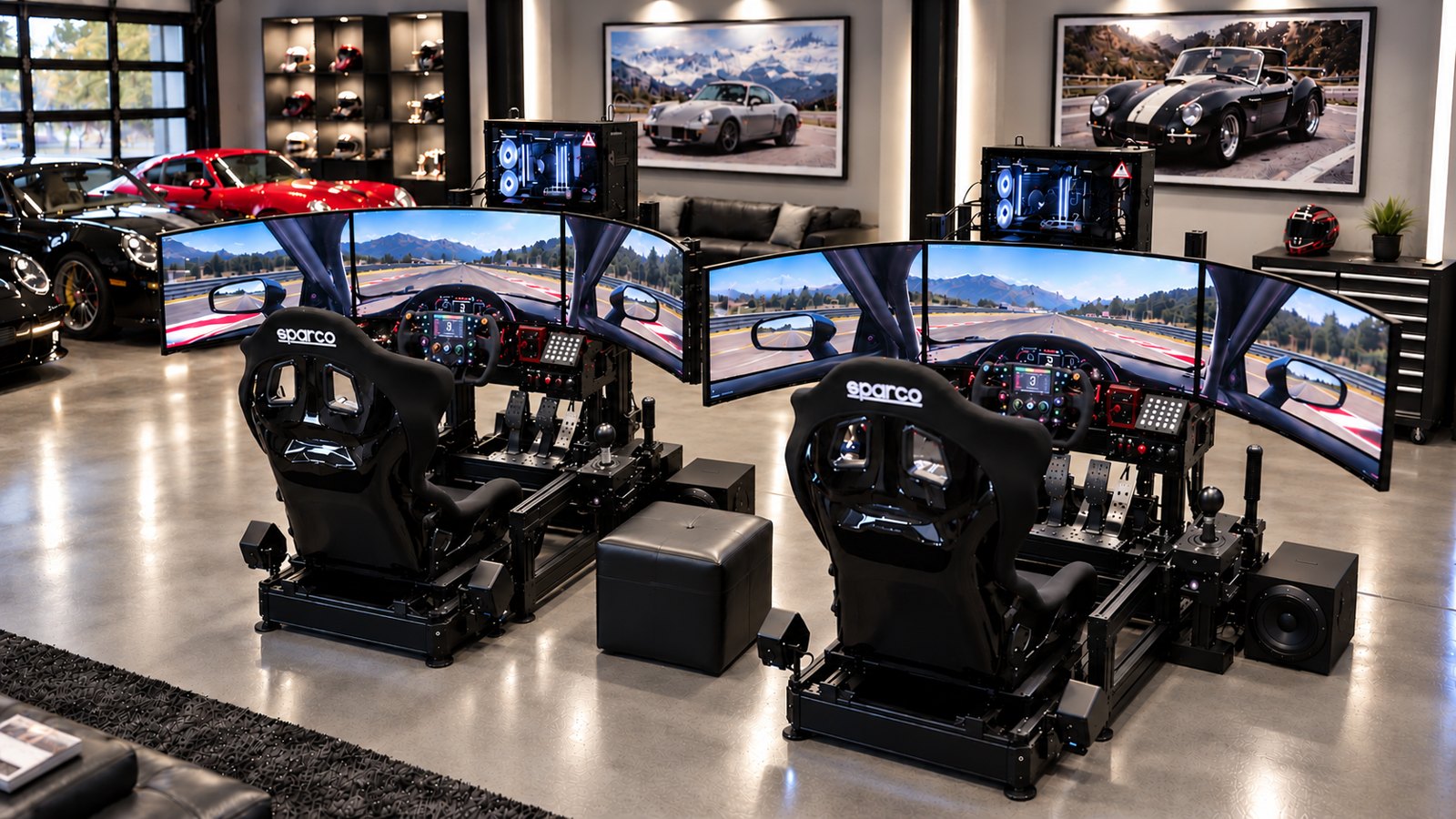
The highest frame rates, Simucube force feedback through wheel and brake, and a streaming kit built in.
- Pro GT chassis
- L3 custom PC
- Simucube Pro direct drive wheel base
- Formula steering wheel and rally wheel
- GT race seat
- Triple ULED monitors, highest fps
- H-pattern and sequential shifter
- Handbrake
- Simucube force feedback brake pedal
- Streaming kit
- Audio headset plus 5.1 surround speakers
- Keyboard, mouse and tray
Why ours
We don't mess about.
It's a minefield out there of options and parts. After twelve years in the sim space we have fine-tuned, tested and selected the best components on the market to build our simulators with. These are all pro-grade sims: strong and reliable.
No compromise on the chassis. We want all of the force feedback directed to the driver, with no nuance lost through chassis flex like many of the chassis on the market today. That matters: it is what gives the most accurate experience for developing a driver's skills.
No compromise on the PC. We future-proof our PCs for years to come, giving you power, speed and reliability in the toughest resolution-rendering and high-compute scenarios.
Feel
What is feel?
Drivers talk about it constantly and rarely define it. Feel is the ability to sense what the tyres are doing before the car has fully shown you, and to respond with the right input, at the right size, at the right moment. It is not a gift. It is a trained connection between your hands, your feet, your eyes and your brain.
Where it comes from
Three channels carry almost all of the information a driver uses. Steering torque: how the wheel loads up and goes light as the front tyres approach and pass their limit. Pedal pressure: the brake and throttle read through force, not travel. Vision: the rate the car rotates, how the horizon moves, how quickly the corner is arriving. The seat of your pants is the fourth channel, and it is the least precise of the four.
How it is built
Feel is pattern recognition. Thousands of repetitions where an input produced an outcome, and the brain learned to predict the outcome before it happened. That only works when the inputs and the information coming back are accurate and consistent. Change the reference and the brain learns the wrong thing.
Why a static rig builds it faster
A direct drive wheel reproduces steering torque with real fidelity. A hydraulic or load cell pedal box reproduces pressure. High frame-rate screens reproduce the visual rate of rotation. Those are the three precise channels, and a static simulator delivers them cleanly, lap after lap. Motion adds the fourth channel as an approximation of a sensation that isn't actually happening, because no simulator can sustain G-force, and the brain starts to lean on it. For driver development, that is a step away from the real car, not towards it.
How we train it
Consistent setup so the reference never moves. A benchmark lap from a coach on the same rig. Review of your speed, steering, throttle and brake traces against that benchmark, corner by corner. Then one thing to change next session, repeated until it is automatic. That is the same process we use in the remote driver review, applied to a simulator.
Only you can develop it.
Feel is a skill, and it is one nobody can give you. It is developed by the individual, through training and repetition, and nothing else. It is essential. It is one of the biggest factors separating an average driver from a good one, and the more feel you have, the faster you will be able to drive.
A simulator is the best and most cost-efficient tool there is for developing it. The up-front cost looks high on its own. Set it against a season of track days, tyres, travel, fuel and team costs and it pays for itself in short order, and it is a one-time purchase you will use for years. Simulator software keeps improving and the platform is future-proof, so it is the fastest way to take time off your lap times and keep taking it off.
If you don't have a sim today, you will be left behind on track tomorrow.
Aptitude
What is aptitude?
The dictionary definition: a natural ability or capacity to learn and do something well. It is not the skill itself. It is how quickly and how far you can develop the skill.
In practical terms, in motorsport, aptitude is your ability to develop feel. The drivers who can develop feel the fastest have the best aptitude. That is what talent scouts are really looking at when they watch a young driver: not how fast they are today, but how quickly they are getting faster.
Feel and aptitude cannot be taught. They can only be developed by the individual, and practice is how they are developed. Nobody can do the laps for you.
What coaching does is keep you on the right line through that journey. A coach shows you which skills to work on, in which order, and how to practise them so each session counts, which saves the time and money you would otherwise spend learning the wrong things well. Practice builds the feel. Coaching makes sure you are practising the right thing.
With feel and aptitude working together you have the foundational skills to be competitive. That is the journey to becoming a good driver.
The step from good to great is more psychological than physical. It is part of a wider, higher-level program we offer to Pro-Am and Pro drivers to improve their peak performance. Ask about it.
Optional extras
Add what you'll use.
Priced as ranges; the final figure depends on the level and your room.
Motion system
Available on Level 2 and 3 builds, adjustable from subtle to a lot of movement depending on the system. Read our view on motion below before you decide.
VR system
Headset and setup for full immersion, alongside or instead of screens.
Remote driver coaching
Live, real-time coaching on track with one of our pro coaches, on voice while you drive. Book by the hour once the rig is in.
Our advice on motion
Static for training. Motion for fun.
These are professional-grade simulators specified for serious drivers and for driver development first. That shapes how we think about motion.
Motion teaches your brain to build feel from a sensation that isn't real. The reason is G-force. G-force is the sustained acceleration you feel as a load on your body: the pull into the seat under hard braking, the push sideways through a fast corner, measured in multiples of gravity. A real car holds that load for as long as the corner lasts. A simulator cannot: a motion platform can tip or jolt you for a moment, but it cannot sustain G-force, so it gives you the onset of a sensation and none of the load that follows. That is the sensational difference between the real car and the simulation, and it is why motion is not an accurate input for training.
The hand-eye development that produces real feel, reading the car through the wheel, the pedals and what you see, is very accurate on a static rig. Training on a static simulator will improve your driving significantly more than training on a motion simulator, which is why every level is specified static as standard.
For an all-round fun experience, motion is excellent. It can be adjusted from minimal to a lot of movement depending on the range of the system you choose, and it can be added to a Level 2 or Level 3 build. If you want it, ask and we'll talk you through the options.
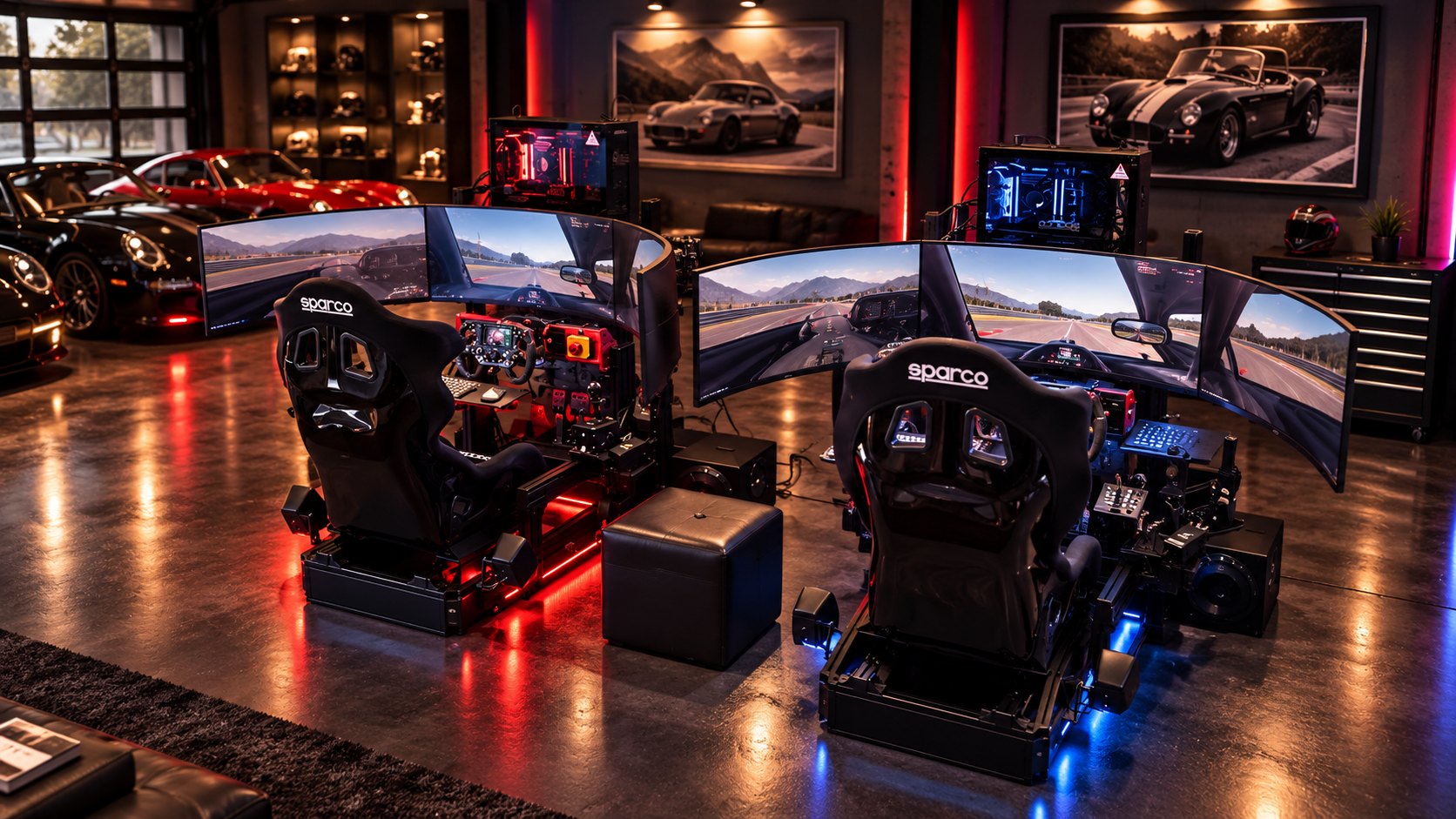
Ask about motionWhat each step up buys you
How it works
Tell us the space
Room, power, what you drive and want to drive, and whether screens or VR. A short call settles the level.
Fixed price, your spec
A written spec and one all-in price for the build, pre-test and install, with a two-year hardware warranty. A deposit secures the build slot.
Driving on day one
Installed in your space, software and profiles set up, and a handover session so you can use all of it.
Request a build
Tell us about the room.
Fill this in and we'll come back with questions and a spec. No deposit until you've approved the quote.
Request ready to send
Your email app should open with everything filled in. If it didn't, copy the summary and email it to [email protected].