

Sample data review · Sebring test day
Where 5.4 seconds
actually go.
Same car, same day, same track: a Toyota Supra GT4, WRL spec, on Yokohama Advan DOT 200 tyres, at Sebring. The coach's 2:17.4 laid over a client's 2:22.8 from the VBOX data, corner by corner. This is what a review looks like when you send a data file with your video. Send video only and you get a narrated coaching review recorded over the lap instead.
01 · Side by side
Two laps, synced from the start line.
Coach on the left, client on the right, both starting on the line at the same moment. Watch who is on the throttle first out of every corner. That is the whole review in one video.
02 · Full lap overlay
Speed, throttle, brake and the gap, against distance.
is the coach, orange is the client. The bottom trace is the running gap: wherever it climbs, the client is losing time. The shaded zones are the three places it climbs fastest.
03 · Where the time goes
By section, biggest first.
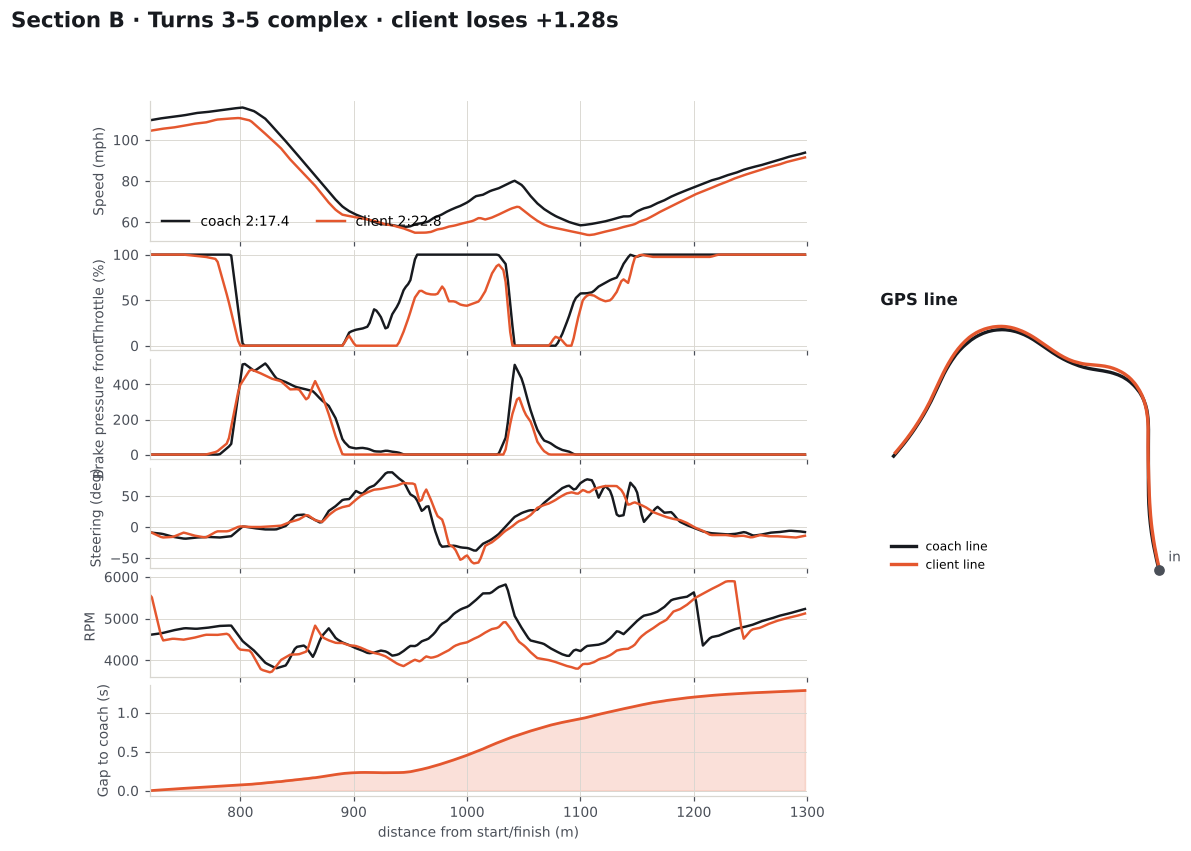
- BTurns 3–5 complex+1.28 s
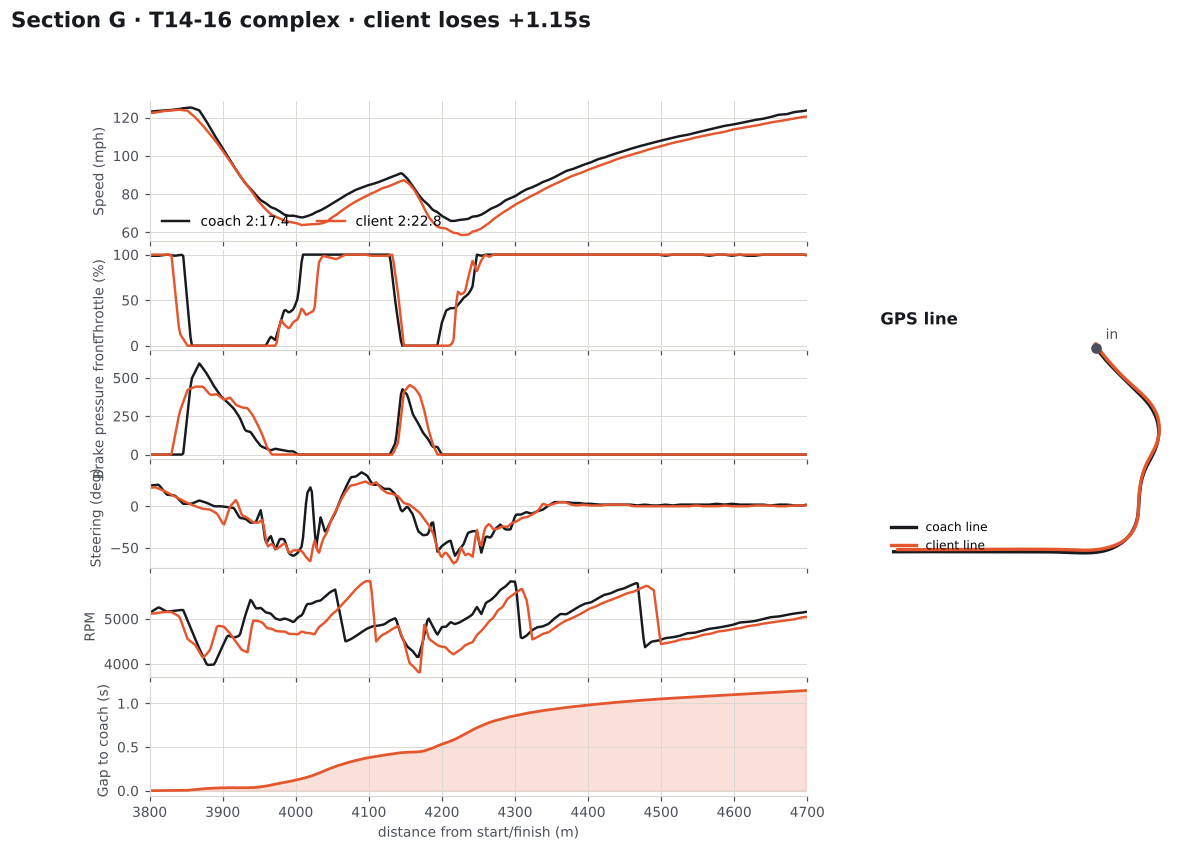
- GTurns 14–16 complex+1.15 s
- ATurn 1+0.77 s
- HSunset (17) and main straight+0.56 s
- FTower (13) and Ullmann straight+0.55 s
- ETurns 10–12+0.42 s
- CHairpin (7) and approach+0.37 s
- DTurns 8–9 and straight+0.07 s
The first three sections are 3.2 of the 5.4 seconds. Fix those and the lap is a 2:19 without touching anything else.
Orange on the map is where the gap is growing fastest. Letters match the chart and the list.
04 · Priorities
In order. Biggest loss first.
Turns 3–5 complex: throttle too late, then never committed
What the data shows
- Same braking point (790 m) and almost the same line, so this is not where the time is.
- Off the throttle for 60 m longer after the first apex: the coach is feeding in 20% at 900 m and at full throttle by 960 m; the client is at zero until 950 m, then sits on a 50–60% plateau and never reaches full throttle before the next brake.
- That plateau costs 13 mph into the second part of the complex: 80 mph vs 67 mph at 1030 m.
- Second braking: a soft lean (366) against the coach's firm hit (512), so the braking phase is longer for less speed loss.
- Exit: full throttle at 1160 m vs 1140 m, and lower through the whole run to the hairpin. 1.28 s gone, a quarter of the lap deficit, in 580 m.
What the coach does differently
- Brake release and the first throttle input overlap: there is no gap between the pedals.
- One continuous squeeze from 20% to 100%: the throttle trace has no flat sections.
- Short, hard brake for the second part, then straight back to the squeeze.
- Same gear (3rd) at the same RPM at apex; the extra speed is all pedal timing.
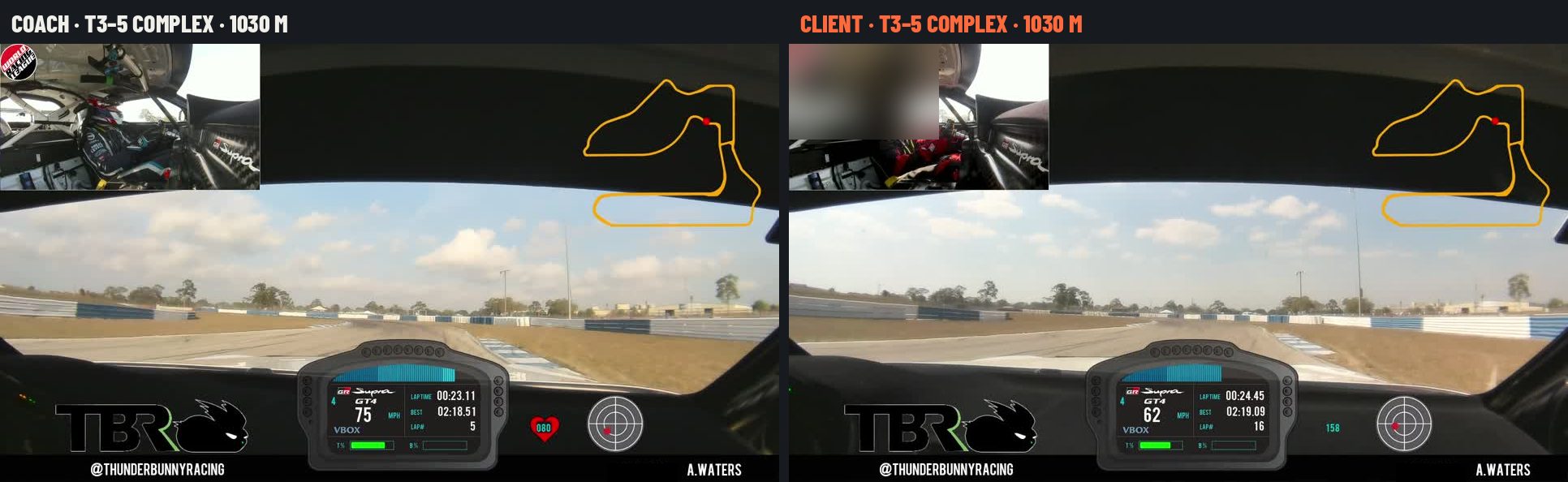
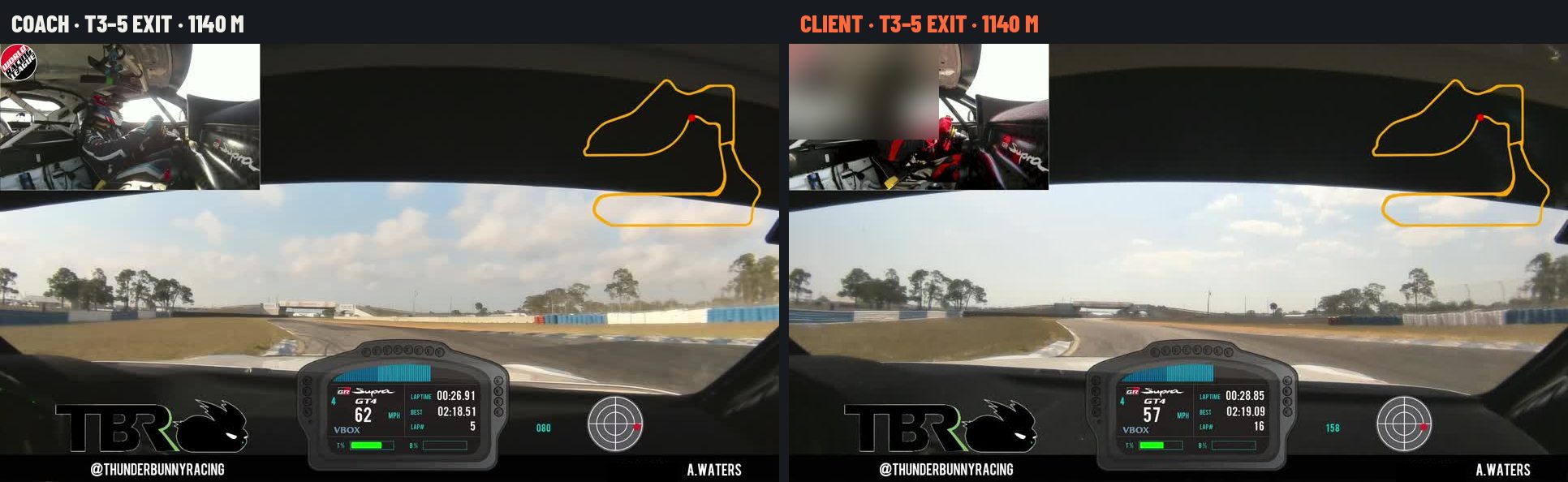
The fix
The throttle goes on as the brake comes off, not after the car is straight. Once the car is pointed at the second part, it is one progressive squeeze to the floor with no plateau. Treat the second braking point as a hit, not a lean: harder pressure for a shorter time, then back to the squeeze.
The drill
Three laps saying "brake, turn, squeeze" out loud, with no pause between the words. Check the throttle trace afterwards: the target is no flat sections between apex and the next braking point.
Turns 14–16 complex: over-slowed, too much lock, half-throttle exits
What the data shows
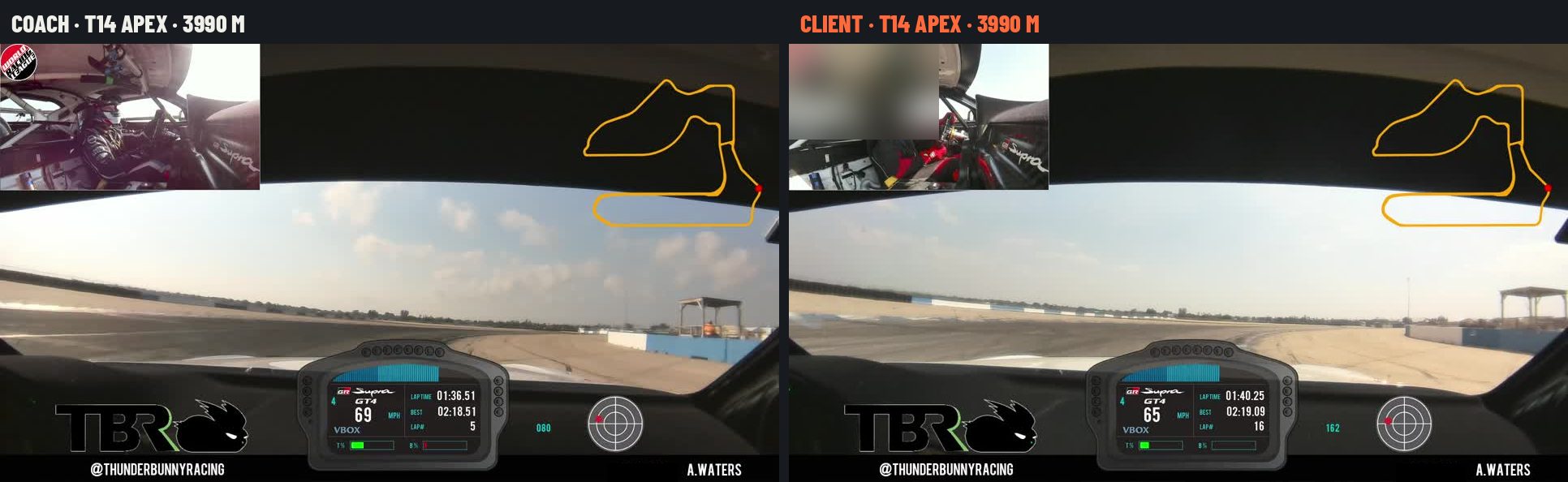
- First corner: brakes 15 m earlier and 25% softer (442 vs 594), so the braking is long and the car arrives slower than it needs to.
- Throttle picks up 40 m later and climbs to full 50 m later (4060 vs 4010 m), through a 40% plateau. Exit speed 83 vs 90 mph.
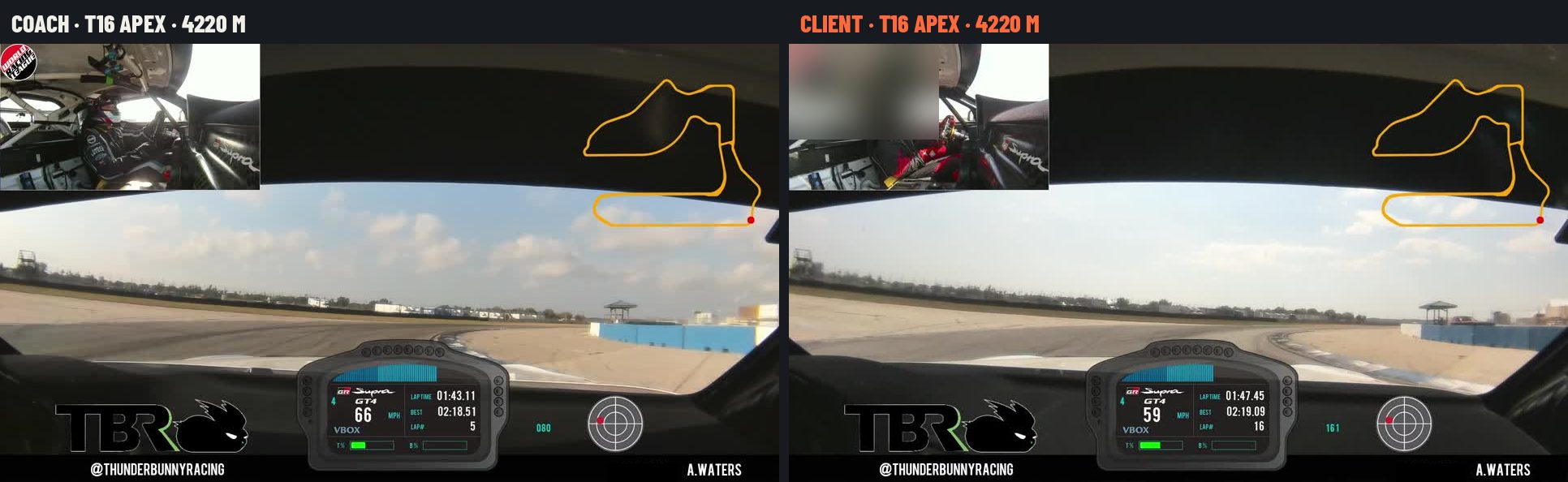
- Second corner: minimum speed 60 mph vs 66 mph with 13° more steering lock (69° vs 60°). The car is slower and being turned harder: an early, tight turn-in that kills apex speed.
- Throttle 20 m later out of the second corner, then a gentler ramp. The whole run to Sunset is 2–4 mph down.
- Shifts come 150 rpm later than the coach's (5,900 vs 5,750), with no gain from it.
What the coach does differently
- Later, harder brake in one hit, released as the steering goes on.
- Less lock, later apex: the coach carries 6 mph more with less steering.
- Throttle at the apex and one squeeze to full; no half-throttle plateau.
- Short-shifts slightly earlier; the engine is not where the time is.
The fix
Brake later and harder into 14, and bleed it off as you turn so the speed stays in the car. Into 16, turn in later with less lock: the car can carry 66 mph here, and the extra lock is what is slowing it. Then throttle at the apex, not after it.
The drill
Pick the turn-in reference for 16 and move it one car length later for three laps. Aim for a minimum speed of 64 mph on the dash, then 66. If the steering feels like less work, that is the point.
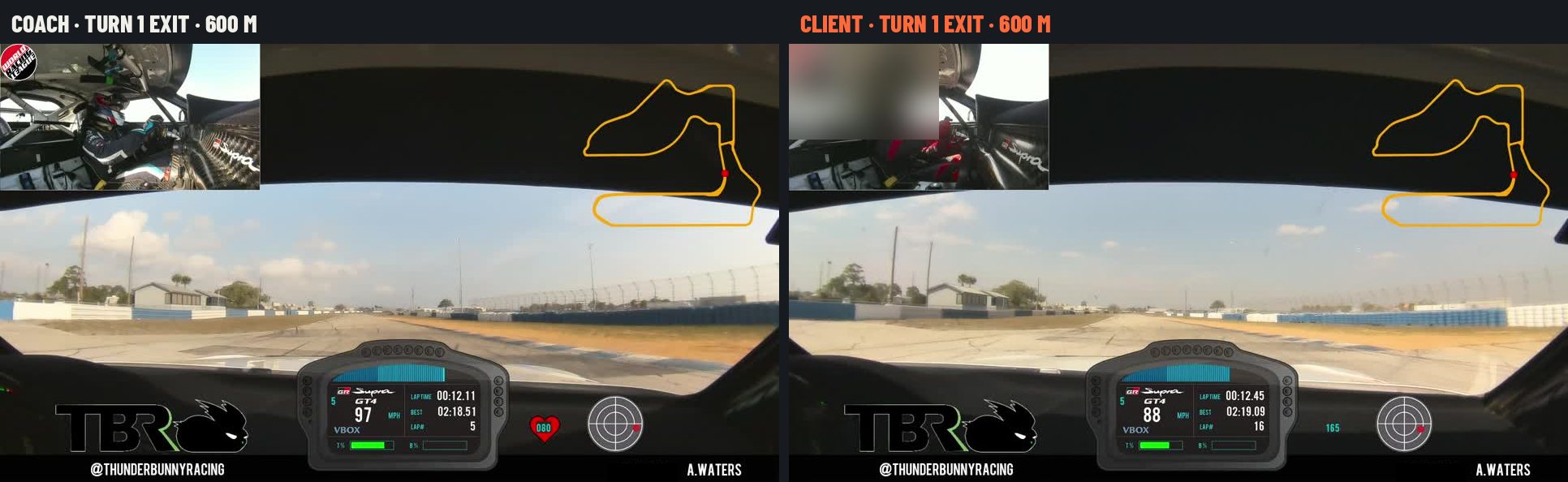
Turn 1: the 100 m coast between brake and throttle
What the data shows
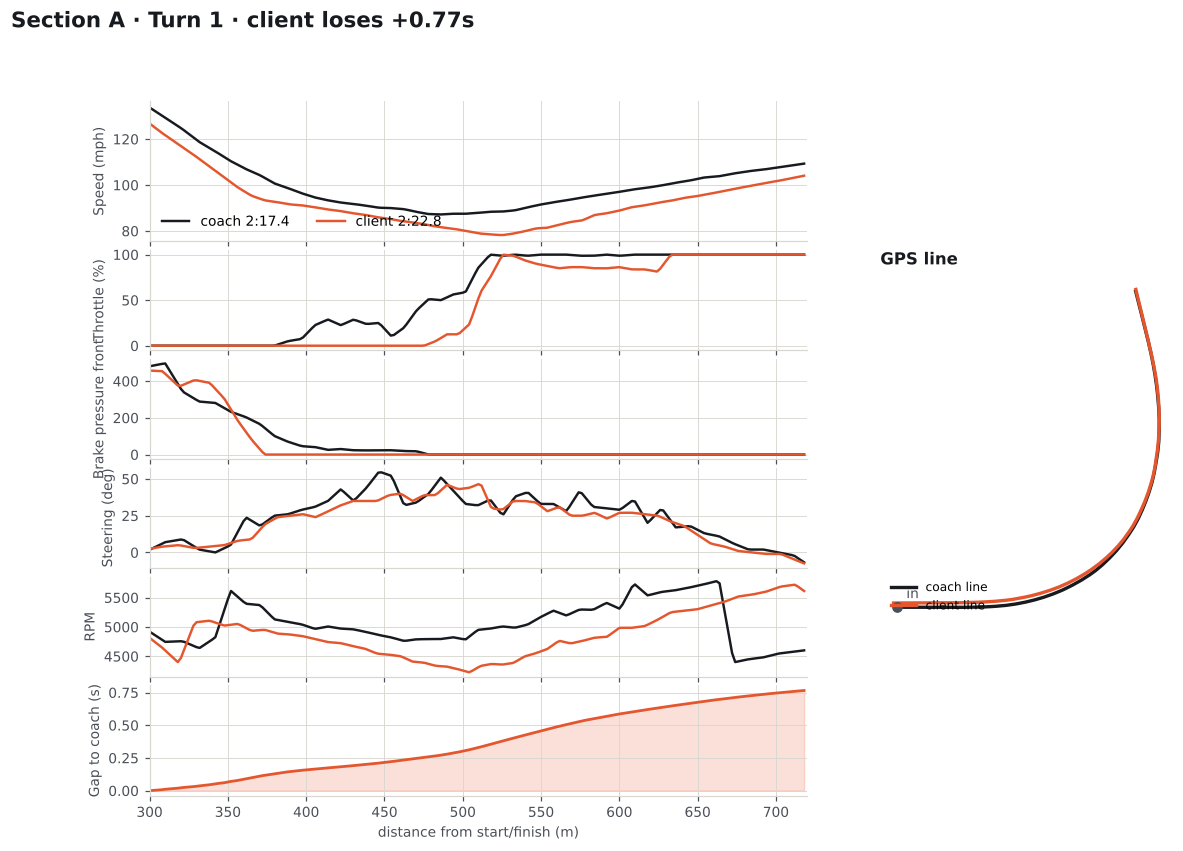
- Both brake at about 280 m with similar peak pressure. The difference starts at the release.
- The client drops the brake completely at 370 m and then has neither pedal down for 100 m, from 370 to 470 m. The coach trails light pressure to 460 m and is already on 25% throttle by 390 m.
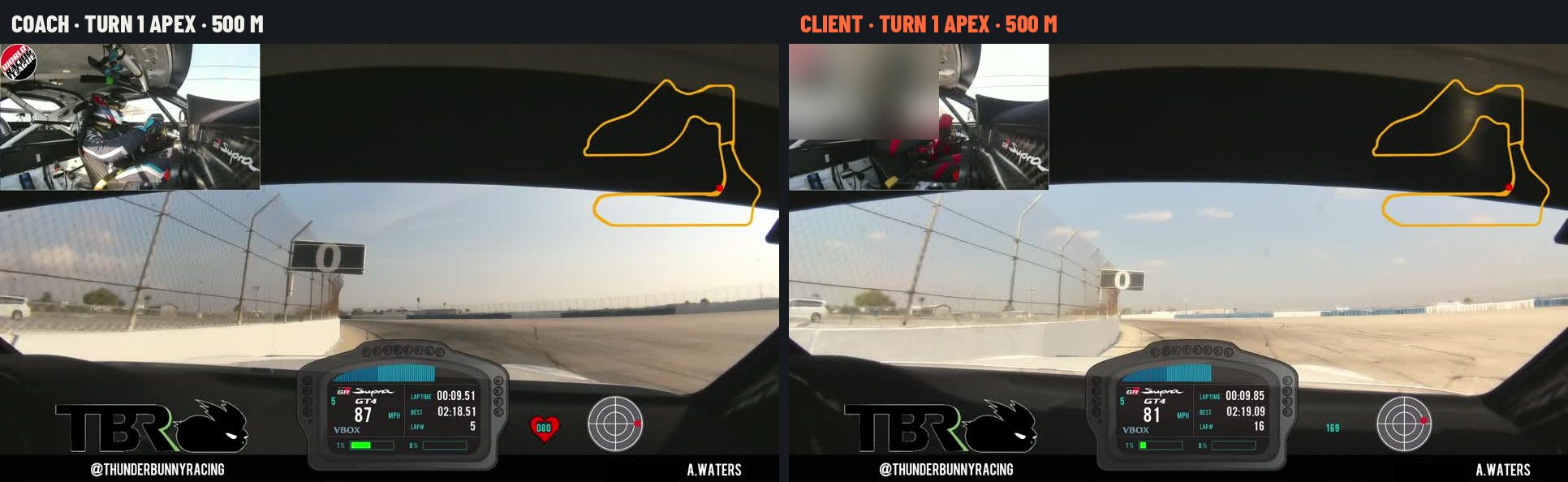
- Minimum speed 77 mph vs 87 mph on the same line.
- Full throttle at 630 m vs 520 m: 110 m later, after an 80% plateau.
- Nearly 0.8 s lost before the lap has really begun, and it is paid for again all the way down the straight to turn 3.
What the coach does differently
- Bleeds the brake off over 100 m as the steering goes on, so the nose stays loaded and the speed stays in.
- On a maintenance throttle through the apex; one pedal is always down.
- Squeezes to full as the car straightens, with no plateau.
The fix
The brake release is the corner. Come off the pedal over 100 m rather than dropping it, and be on a maintenance throttle by the apex. Never coast: if the brake is coming off, the throttle is going on.
The drill
Five laps where the only thing you watch in turn 1 is the dash minimum speed. 80 first, then 83, then 85. Do not change the braking point; change how long the release takes.
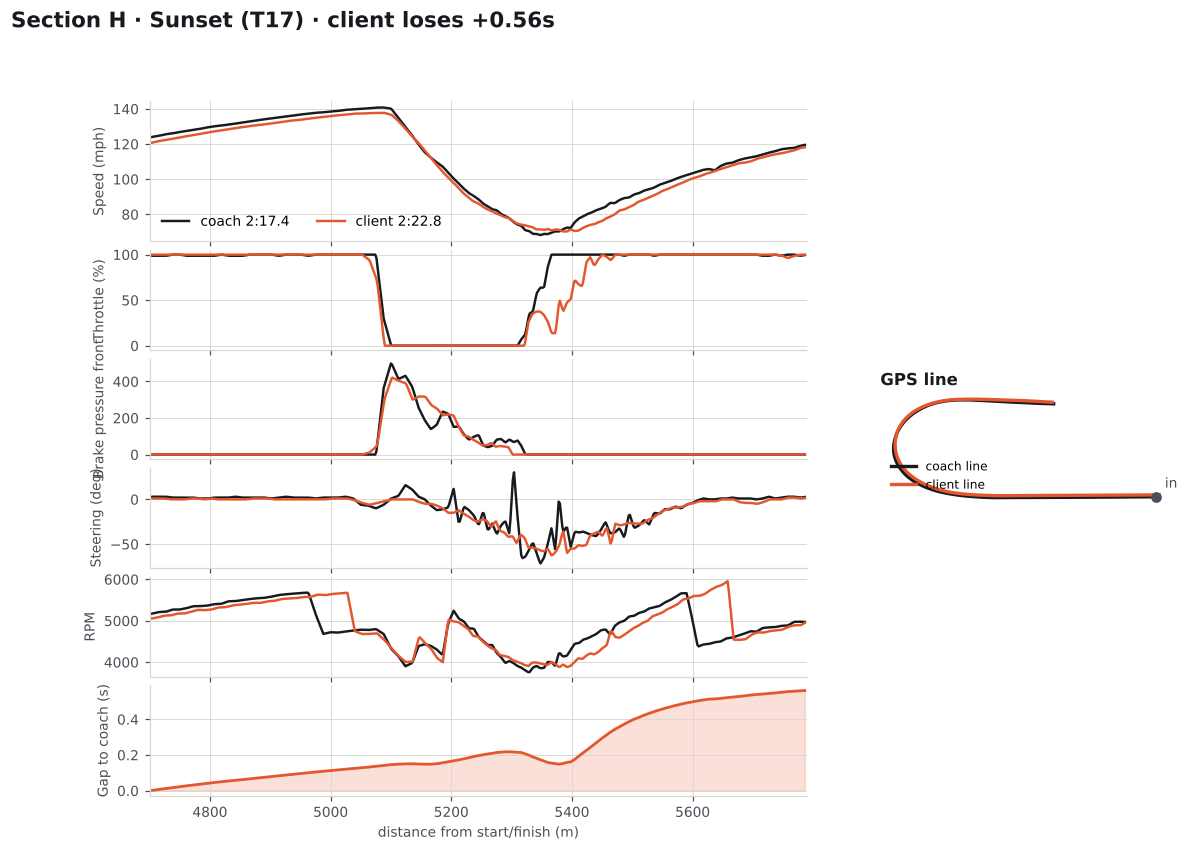
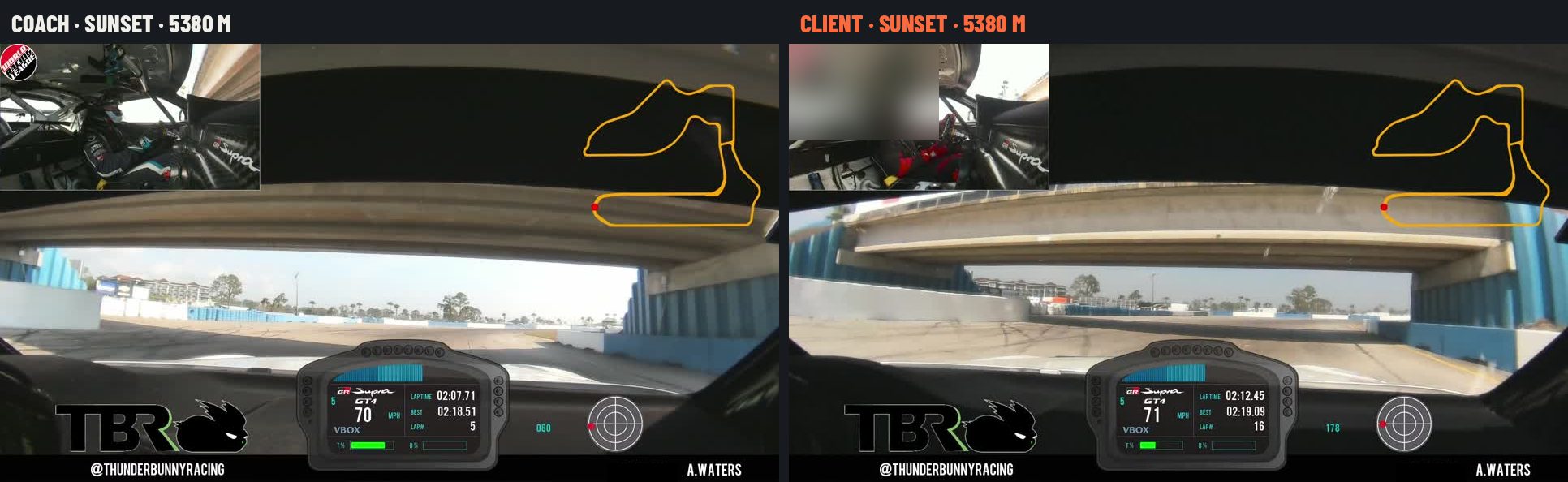
Sunset (turn 17): throttle 40 m late onto the longest straight
What the data shows
- Brakes 10 m later than the coach but 25% softer (318 vs 432), so the braking phase is still longer.
- Minimum speed is actually fine (113 vs 110 mph).
- Throttle 40 m later (5386 vs 5348 m) and gentler, so the exit is slower and the deficit grows all the way to the start/finish line.
- The kink before Sunset is taken 3 mph slower.
What the coach does differently
- Commits to the throttle at the apex of Sunset; the straight is where this corner pays.
- Same gear, same line, 40 m earlier on the pedal.
The fix
The minimum speed is already there; this one is purely commitment. The throttle goes on at the apex, not when the exit kerb is in sight. On a 1 km straight, 40 m of throttle is half a second.
The drill
Pick a reference on the inside at the apex of Sunset. The throttle starts at that reference, every lap, and goes to the floor in one movement.
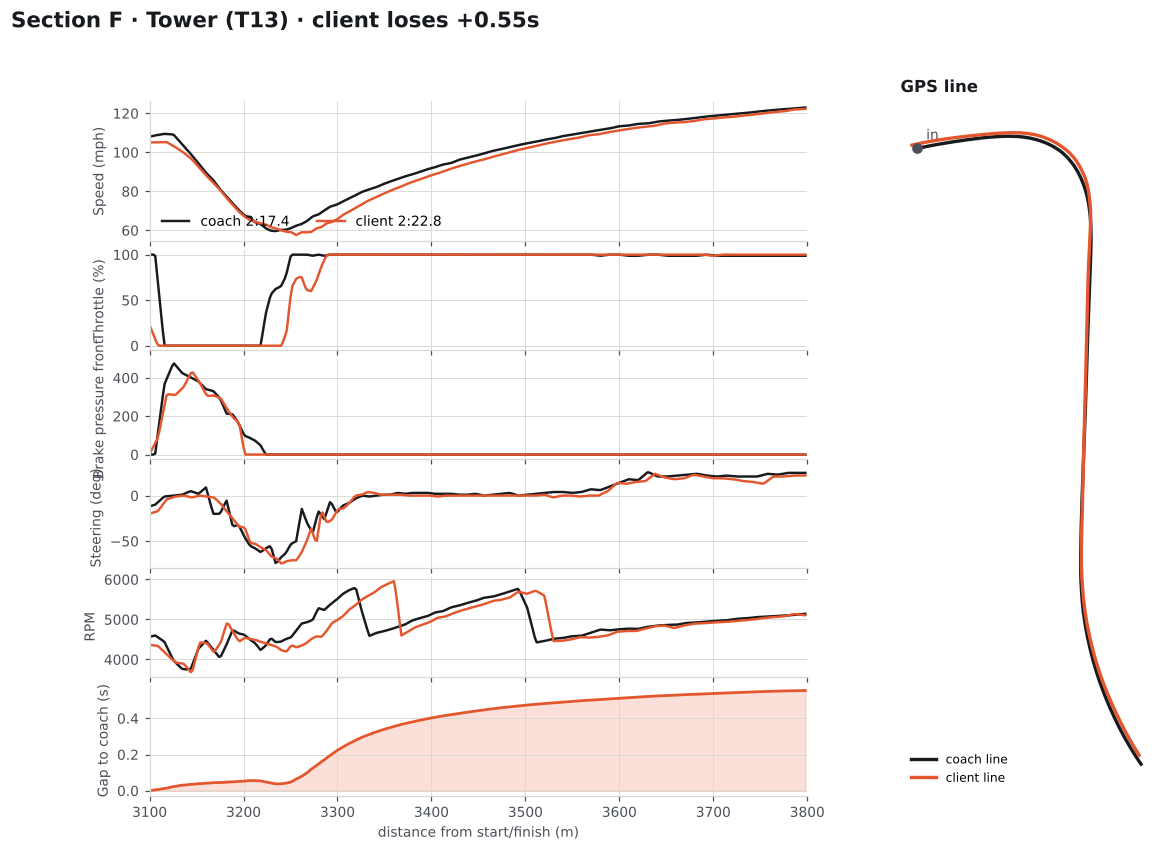
Tower (turn 13): a little of everything
What the data shows
- Same braking point. Peak pressure 10% lower (428 vs 475).
- Throttle 20 m later (3256 vs 3234 m), minimum speed 3 mph lower (93 vs 96).
- None of it is dramatic; all of it compounds on the straight that follows.
What the coach does differently
- Slightly firmer brake, slightly earlier throttle, slightly more speed at the apex.
The fix
Nothing to re-learn here. This corner will come right on its own once the throttle habit from priorities 1 and 3 is in place.
The drill
No specific drill. Re-check after the next session.
Turns 10–12: braking 60 m early
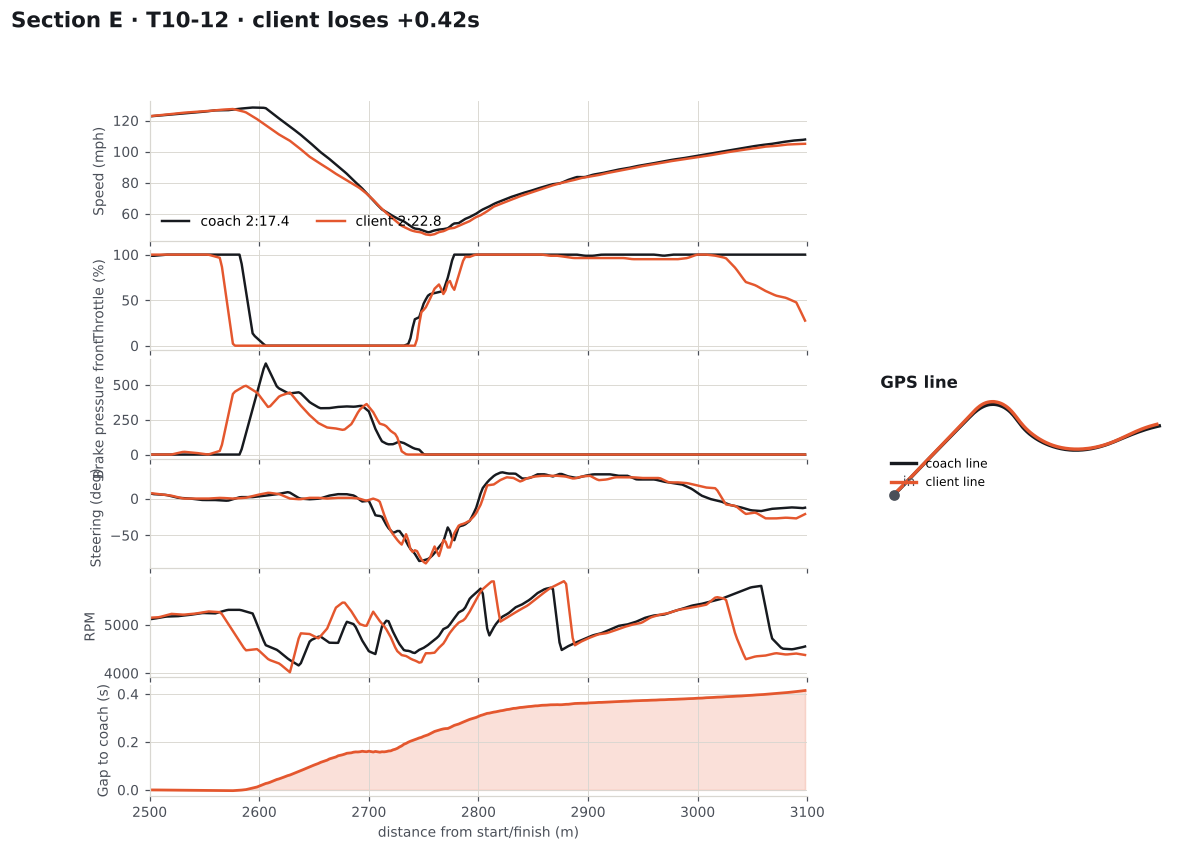
What the data shows
- Braking 60 m earlier than the coach for turn 10 (2522 vs 2584 m), the biggest braking-point difference on the lap, with 25% less pressure (493 vs 652).
- Apex 5 m wider than the coach's line in turn 10.
- Minimum speed 74 vs 77 mph; throttle timing is close.
What the coach does differently
- Brakes 60 m later and much harder, then releases into the corner.
- Tighter apex in 10, which sets up the exit through 11–12.
The fix
Move the braking marker for turn 10 later in two steps of 30 m, and hit the pedal hard at the start. This is the one corner where the braking point itself, not the release, is the problem.
The drill
Two laps at the current marker with harder initial pressure. Then move the marker 30 m later for two laps. Then another 30 m. Stop where it stops feeling like you have time to spare.
05 · The pattern
Four things, not forty.
54% of the lap at full throttle against 69%. The throttle goes on late and climbs through plateaus. Every corner on the lap shows it; this is where most of the 5.4 s lives.
Peak pressure 20–25% lower at every braking point. Braking is a lean, not a hit, so it lasts longer and the gap between brake and throttle grows. Same braking points, so the fix is pressure, not distance.
6–14 mph down in turns 1, 14 and 16, with more steering lock. The slow corners (7, 10) are within 3 mph. The car is being over-slowed where it can carry speed.
GPS paths are within a car width almost everywhere. Same gears in every corner. Do not change the line; change what the feet are doing on it.
06 · The plan
Next three sessions.
07 · Your lap
This, on your data.
Send one lap of video, with a data file if you have one. Back within 24 hours: an overlay like this one against a reference lap (or, video only, a narrated coaching review over your lap), and the written priorities with a drill for each. More data is better; it is not essential. From $199. The written debrief sample is here.